Customer Update
Customer Update writes data permanently to the borrower's record. While nodes like Ask Question hold data temporarily in variables, that data vanishes when the conversation ends. Customer Update takes those variables and persists them to the database. Without it, everything collected during a conversation is lost.
The node operates silently — no message goes to the customer.
The Data Model
A borrower's profile (see Borrowers API) has several compartments that Customer Update can write to.
Identity stores official document information: national ID numbers, tax IDs, legal names. The system finds an existing record of that type or creates one if none exists.
Borrower fields are custom key-value pairs defined per tenant — the most common compartment. Use it for any business-specific data: customer segment, business type, onboarding progress trackers.
Step advances the borrower through workflow stages. Unlike other update types, step updates don't need a value — selecting the step key moves the borrower to that stage.
Borrower (the core entity) is rarely updated directly. The only common case is setting the label field.
This node doesn't handle addresses or points of contact — those are collections where a borrower can have multiple entries. For those, use Create Entity.
When to Use It
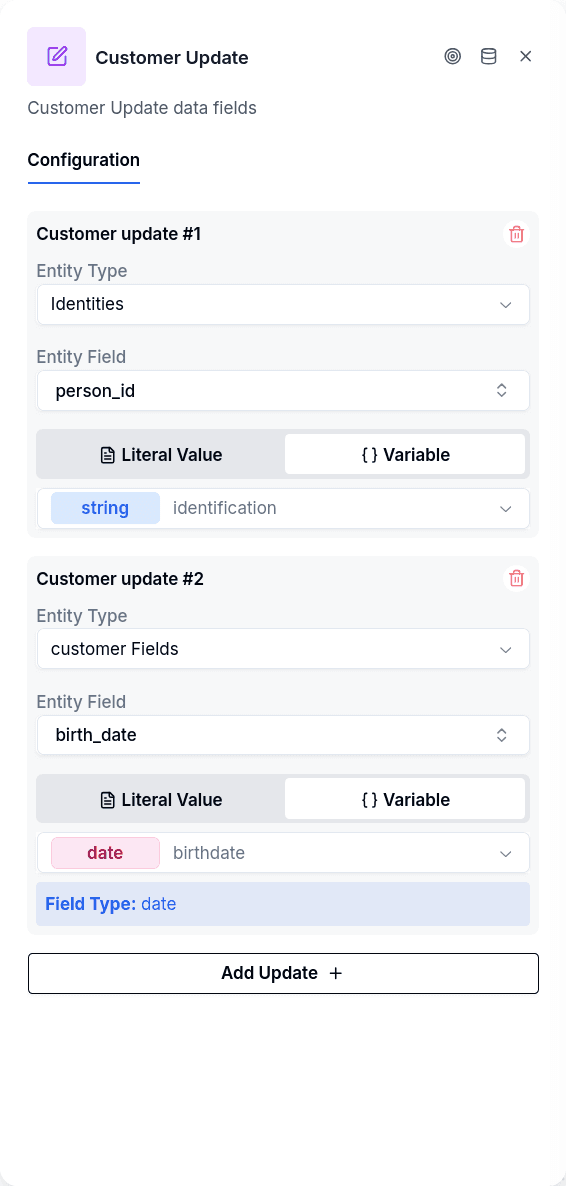
Persisting collected input. After Ask Question collects input into a variable, Customer Update makes it permanent. The customer enters their ID number into identity_value, then Customer Update writes it to identity.person_id.
Tracking multi-step progress. For processes spanning days, store progress in a borrower field like _whatsapp_onboarding_current_step. When the customer returns, a Conditional checks this field and routes them to the right place.
Saving selections. After Interactive Options, each branch can lead to a Customer Update with a static value matching what the customer chose.
Configuration
Each update targets a specific compartment and field, with a value from either a variable or a static string. You can add multiple updates to a single node — useful for saving all collected data at the end of a phase.
For identity and borrower field updates, choose whether the value comes from a variable or is a fixed value. For step updates, you only need the step key — no value required.
Output Handles
| Handle | When |
|---|---|
| Continue | All updates completed successfully |
| Error | Update failed (rarely configured) |
Customer Update vs Create Entity
Customer Update modifies singular fields: identity documents, custom fields, workflow steps. A borrower has one national ID value, one value for any given custom field.
Create Entity adds records to collections — phone numbers, addresses — where a borrower can have multiple instances, each with its own ID.
Store a phone number as text in a custom field? Customer Update. Need a verifiable POC that can receive codes? Create Entity.
Prerequisites
The conversation must be authenticated — a borrower_id must exist from Login or Create Borrower. For variable-sourced values, the referenced variable must exist or the update fails.
Things to Know
Borrower fields can be created on the fly. If the field key doesn't exist in your data model, it gets created when first written. However, fields should be pre-defined for proper typing and UI support elsewhere in the system.
Step updates have no value. When the entity type is "step", there's no value to configure — the step key alone advances the borrower to that workflow stage.