Set Variable
Set Variable transforms and extracts data within a conversation. When a workflow or Python executor returns a nested response, other nodes can't use it directly — the data sits buried in object properties and array indices. Set Variable reaches into those structures using dot-notation paths (info_sri.output.data.0.activity), pulls out the specific values you need, and stores them as simple variables the rest of your flow can reference. Numbers in the path are array indices.
The node operates silently — no message goes to the customer. It processes the configured extractions and proceeds immediately to the next node.
When to Use It
After external integrations. A typical pattern follows a Workflow Execute, Formula, or Python Executor node. These integrations return structured responses with nested data. Set Variable unpacks what you need — extract info_sri.output.data.0.activity into activity, then a Conditional can check it, a message can display it, or Customer Update can persist it to the borrower's record.
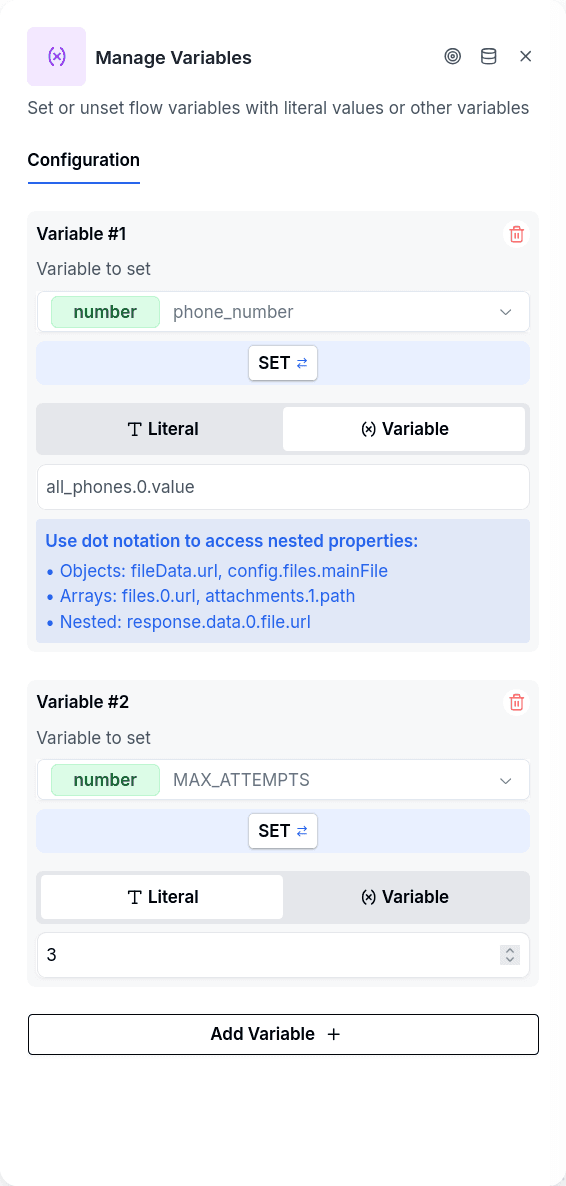
Initializing counters for retry logic. Before entering a loop that might fail, set attempts to 1 and MAX_ATTEMPTS to 3. When the loop fails, a Conditional checks whether to retry or give up.
Configuration
| Option | Description |
|---|---|
| Variable Name | The variable to create or update |
| Data Type | string, number, boolean, date, object, or array |
| Mode | set to create/update, unset to delete |
| Value Type | literal for hardcoded values, variable for path extraction |
| Source Variable | Path to extract from (e.g., info_sri.output.data.0.activity) |
You can define multiple variables in a single node. Path traversal uses dot notation — numbers in the path are array indices.
Unlike Customer Update, which writes to permanent storage, Set Variable only affects the current session. Extract and reshape data here, then persist the final values with Customer Update.
Output Handles
| Handle | When |
|---|---|
| Continue | Processing completed |
If a path doesn't exist, the system logs a warning but continues — the variable simply doesn't get set. If you traverse to an array without specifying an index, you get the whole array; use .0 to extract the first element when you need a single value.