Send Credit Line Information
Send Credit Line Information fetches a borrower's credit account from the Credit Management System (CMS) and stores it in a flow variable. The account object includes the current balance, available limit, and status, with the option to include the full history of credit operations.
This is a different node from Send Credits Information. That node retrieves individual loan and debt records; this one retrieves the credit account itself — the DPA (Deferred Payment Account) product family. The product family is not configurable.
Before this node runs, the borrower must be authenticated and their record must have a linked CMS client ID (typically assigned during onboarding). A variable holding the CMS partner ID must also be set earlier in the flow.
Configuration
| Option | Description |
|---|---|
| Partner ID variable | Required. A string-typed variable holding the CMS partner ID. The node uses it to authenticate the CMS request. |
| Include history | When enabled (the default), the fetched account includes the full history of credit operations. |
| Selected variable | An object-typed variable where the credit account will be stored. |
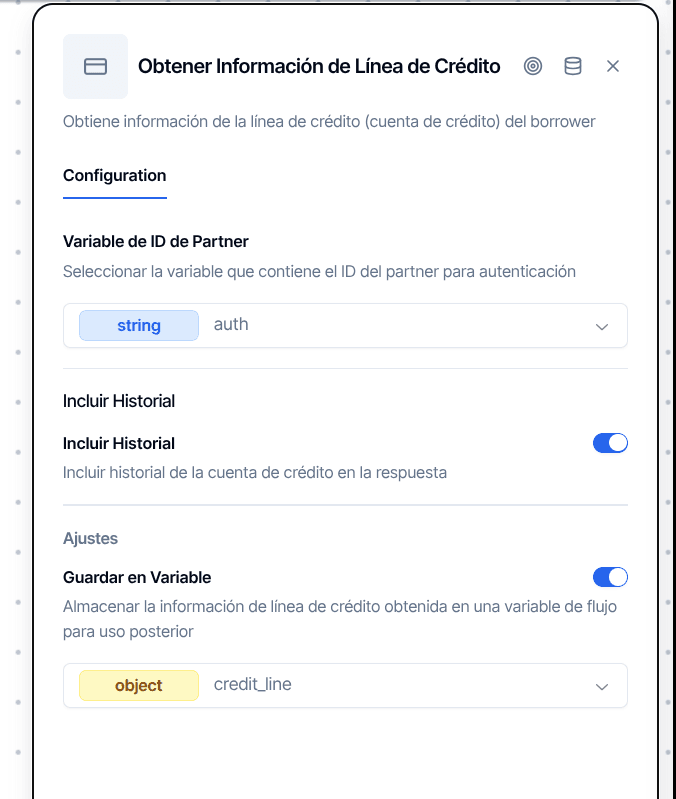
The node runs silently — nothing appears in the chat. It works identically across WhatsApp, Web, and Email flows.
When to Use It
Branching on account status. Retrieve the credit account and feed it into a Conditional node to route the flow based on whether the account is active, suspended, or absent.
Displaying balances. Fetch the account before a Message node so you can show values like {{credit_account.available.amount}} or {{credit_account.outstanding.amount}}.
Feeding downstream API calls. Pass the stored credit account object to an HTTP Request or Workflow Execute node that needs credit context.
Output Handles
| Handle | When it fires |
|---|---|
| Continue | Account retrieved successfully |
| Error | Missing partner ID variable, borrower not found, no CMS client ID, or API failure |
Things to Know
Always connect the Error handle. Missing partner ID, unresolved borrower, absent CMS client ID, API failure — any of these routes to Error. Without a connected path the flow terminates silently and falls back to the connector's default responder.
Soft failures stay invisible in the conversation. If the partner ID is missing, the borrower is not found, or the CMS client ID is absent, the error is logged on the backend but nothing appears in the conversation. Only CMS API failures (network errors, HTTP errors) surface a visible notice. Check backend logs if the node silently routes to Error.
The node always uses the first CMS client ID. If the borrower has multiple linked CMS client IDs, only the first one is queried. There is no way to select a different one.