Message
The Message node sends text to the customer without expecting a response. It delivers one or more messages and immediately continues to the next node.
This makes it the workhorse of conversational design. Before you ask for sensitive information, you explain why you need it. After a customer submits documents, you acknowledge receipt. When a backend process takes time, you tell them to wait. The Message node handles all of this.
When to Use It
Before asking for input, a Message can explain what you need and why. Customers who understand the request make fewer mistakes. A brief explanation before requesting a government ID reduces failed attempts and support tickets.
After collecting data, a Message confirms what was captured. After branching logic, it communicates the outcome. During long operations, it manages expectations—silence feels like broken software, so a brief "Processing your information" keeps things moving.
How It Works
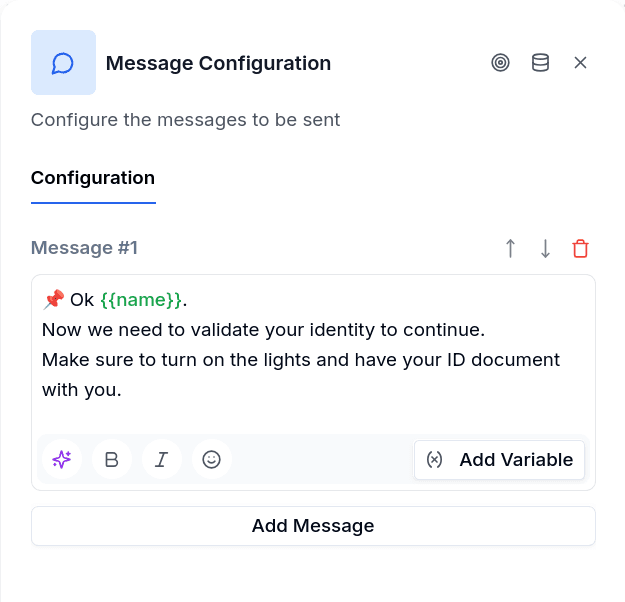
Each Message node contains one or more text entries. Add them through the editor—you can reorder, delete, or use the AI assistant to help draft your text. When the node executes, messages arrive as separate chat bubbles in quick succession, then the flow moves on.
The description field is for your reference only; it shows on the canvas but never reaches the customer.
Variables
Use {{variable_name}} to personalize messages. Three variables are always available:
{{name}}— the customer's WhatsApp name{{phone}}— their phone number{{borrower_id}}— their ID in the system
Any variable stored earlier in the flow works too. If a variable doesn't exist at runtime, the message shows [VAR NOT FOUND] instead—so double-check your spelling.
Formatting
Messages support WhatsApp markdown: surround text with *asterisks* for bold or _underscores_ for italics. Emoji work well as visual anchors—✅ for success, ❌ for errors, ⏳ when asking customers to wait.
Multiple Messages
Most nodes use a single message. Multiple messages make sense when content benefits from visual separation—chunking instructions so they don't arrive as a wall of text.
Failure Behavior
Message nodes don't wait for delivery confirmation. If sending fails, the flow continues anyway and resets to the connector's default responder.