Read Borrower POC
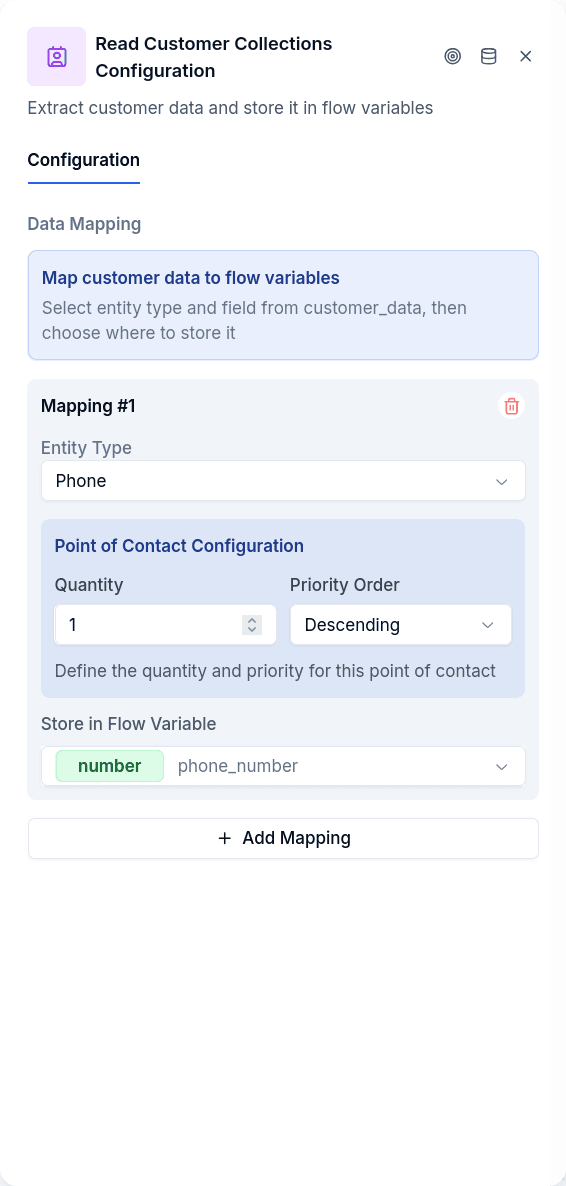
Read Borrower POC retrieves contact information — phones, emails, and addresses — from a borrower's Points of Contact records. It's a specialized sibling of Read Borrower: same backend, narrower scope, but with controls for quantity and priority sorting that make sense for contacts but not for identity fields.
A borrower can have multiple phone numbers or email addresses, each with a priority value (1 is highest, 2 is lower, and so on). When you need the main phone for OTP verification, you want priority 1. When you need all emails for a notification workflow, you want several at once. Read Borrower POC exposes these controls directly — set the quantity and sort direction, and the node handles the rest.
What It Can Read
Phone retrieves phone contact values — an array of phone numbers (just the values, not the full POC objects) sorted by priority.
Email retrieves email contact values. Same behavior — an array of addresses, priority-sorted.
POC Address retrieves address records. Unlike phone and email, this returns full address objects since addresses have multiple components.
All three return arrays, even when quantity is set to one. If you need a single string for a message template, use Set Variable to extract the first element.
Configuration
| Option | Description |
|---|---|
| Entity Type | What to read: phone, email, or poc_address |
| Flow Variable | Variable to store the results |
| Quantity | How many records to fetch (default: 50, effectively "all") |
| Priority Order | Sort direction: ascending or descending by priority number |
You can define multiple mappings in a single node.
Output Handles
| Handle | When |
|---|---|
| Continue | Data loaded successfully |
The node doesn't branch on failure. If the borrower has no contacts of the requested type, the variable is set to null and the flow continues.
Prerequisites
The conversation must be authenticated — a borrower_id must exist from Login or Create Borrower.