Ask Question
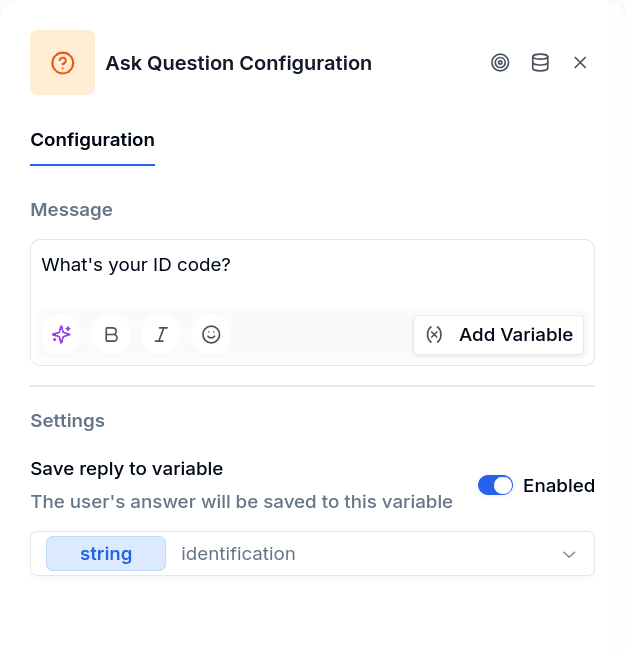
Ask Question is the simplest input node. It sends a prompt, waits for the customer to type something, and stores whatever they send. No validation, no format requirements — any text response is accepted.
Use it when you need open-ended input: names, business descriptions, custom IDs. If you need the response in a specific format — a valid email, a phone number, a date — use the specialized Ask nodes instead (Ask Email, Ask Phone, Ask Date).
How It Works
You write a question, pick a variable to store the answer, and connect the node to whatever comes next. When the customer responds, their text goes into the variable and the flow continues.
When to Use It
Collecting identity information. Ask for document numbers, tax IDs, or other identifiers that vary by country and don't follow a single pattern.
Gathering business details. Company names, descriptions of economic activity, job titles — information that's inherently freeform.
Building addresses step by step. Many flows collect addresses field by field: street, neighborhood, city, state. Each Ask Question stores one piece, and the flow assembles them. Progress indicators help customers know where they are: "[Address 1 of 4] What's the main street?"
Capturing information with examples. For questions where customers might not know what to write, include examples in the prompt: "What's your business's main activity? (Example: Selling auto parts, lubricants, etc.)"
Variables
Select a variable to store the response. The variable is then available to all downstream nodes — you can display it in a Message, check it in a Conditional, or send it to a Workflow.
If you don't select a variable, the system generates one automatically, but it's better to name it yourself. Clear names like company_name or address_street make the flow easier to maintain.
Adding Validation After the Fact
If you need to validate the response but Ask Question is still the right input type, add a Conditional node after it. Check whether the value meets your requirements, and route back to Ask Question if it doesn't — with a Message explaining what went wrong.
Output Handles
| Handle | When it fires |
|---|---|
| Success | Customer responded and the value was stored |
| Error | Something failed (message couldn't send, storage failed) |
Email Flows
In email flows, Ask Question appears as Collect Reply in the node panel and configuration sheet. See Email connectors for channel setup. The mechanic is the same — send a message, wait for the customer to respond, store what they wrote — but the medium changes how things play out. On WhatsApp, the customer is holding their phone. On email, your message lands in an inbox and the reply might come minutes or days later.
The flow waits. There is no timeout. The next email from the same address — whenever it arrives — is treated as the response and advances the flow. If that reply arrives after the flow has already ended, a new flow starts from the entry node.
Everything stays in one email thread. The subject line carries over from the original, prefixed with "Re:" if it isn't already. The outbound message is HTML-escaped plain text — markdown formatting like *bold* will show up as literal asterisks in the customer's inbox.
Reply handling. Email replies carry quoted history — the previous messages in the thread, forwarded headers, signatures. The system strips all of that before storing the response. Gmail-style "On [date] wrote:" headers, Outlook "From: / Sent:" blocks, separator lines, and > quoted lines are all removed. What reaches your variable is only the new content the customer typed.
Attachments. Enable Store attachments and select a variable to capture files the customer attached to their reply — a single URL for one file, an array for several. This works on all channels, but it is especially relevant on email where attachments are how people typically share documents.
Template variables. {{name}} and {{phone}} resolve to empty strings on email — there is no WhatsApp profile to pull from. Use variables you have collected earlier in the flow instead.