Send File
The Send File node delivers a file to the customer — an image or a document — as part of the conversation. Unlike Ask File which receives uploads, this node sends files outbound. Use it to deliver generated PDFs, promotional images, or any document the customer needs to receive.
How It Works
The node takes a URL, downloads the file, stores a copy internally, and sends it through the conversation channel with an optional caption. Once delivered, the flow continues immediately to the next node — there is no pause waiting for the customer to respond.
This makes Send File part of the "auto-advance" family of nodes. It executes, delivers, and moves on. Chain it with a Message node to explain what you're sending, or follow it with an Ask Question to confirm receipt.
When to Use It
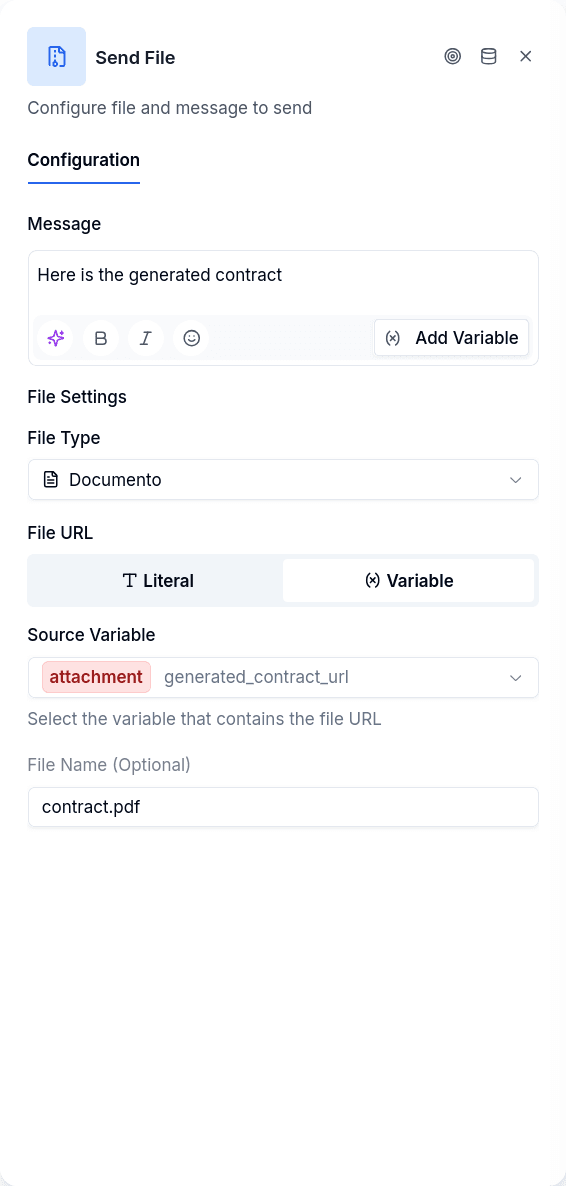
Delivering generated documents. A workflow generates a contract, quote, or receipt as a PDF. The URL ends up in a variable, and Send File delivers it to the customer. Configure the node to read the URL from that variable, set the file type to document, and add a caption explaining what they're receiving.
Sending promotional materials. You have a fixed image or PDF that every customer should receive — a brochure, terms and conditions, or welcome packet. Use a literal URL pointing directly to the file. The same file goes to everyone.
Sharing images without explanation. Sometimes a picture speaks for itself. Configure the node with an empty caption and just the image URL. The customer receives the image with no accompanying text.
URL Sources
You can provide the file URL in two ways.
Literal URL means you type the URL directly into the configuration. Good for static files that don't change between customers — promotional images, standard documents, fixed resources.
Variable URL pulls the URL from a conversation variable. Good for dynamic files generated during the flow. A workflow might create a personalized contract and store the URL in a variable; Send File reads that variable and delivers the file.
If you choose variable URL and the variable doesn't exist, the system logs a warning and the download fails. The flow routes to the error handle.
File Types
The node supports two file types: image and document.
Images are sent as native photos through the channel — on WhatsApp, they appear inline in the chat with the caption below. Documents are sent as downloadable files — on WhatsApp, they appear as file attachments that the customer taps to download.
Choose the type that matches your content. A promotional photo should be an image. A contract PDF should be a document. The file type affects how the channel renders the content, not just metadata.
Output Handles
| Handle | When it fires |
|---|---|
| Success | File delivered successfully |
| Error | Download failed, URL inaccessible, or unsupported file type |
Things to Know
Video is not supported. The configuration interface shows video icons, but the backend only handles images and documents. Attempting to send a video will fail and route to the error handle.
GCP signed URLs work, but require extra processing. Google Cloud signed URLs have access restrictions that prevent WhatsApp from fetching them directly. The system detects these URLs and handles them specially — downloading the file, re-uploading it to WhatsApp's media API, then sending via media ID instead of URL. This happens automatically, but it's worth knowing if you're troubleshooting slow delivery times.
Files are preserved internally. Every file sent through this node is downloaded and stored in internal storage, regardless of what happens with the original URL. If your source URL expires — common with signed URLs or workflow-generated files — the system still has a copy attached to the conversation record.
Differences from Ask File
Send File and Ask File are complementary — one sends, one receives.
| Aspect | Send File | Ask File |
|---|---|---|
| Direction | Bot to customer | Customer to bot |
| Waits for response | No | Yes |
| File source | URL (literal or variable) | Customer upload |