Interactive Options
Interactive Options presents the customer with a set of choices, each leading to a different path in the conversation. It is the primary tool for branching based on decisions — when you need the customer to pick from a discrete set of options rather than type a freeform answer.
Think of it as a fork in the road where the customer chooses which way to go. "Are you a natural person or a legal entity?" Two buttons, two paths, two completely different onboarding sequences that follow.
How It Works
The node sends a message with your prompt text and displays the options as buttons. The customer selects one, and the conversation routes to whichever node is connected to that option's output handle.
Each option you add creates its own output handle. You connect each handle to a different next step, and the customer's choice determines which branch executes.
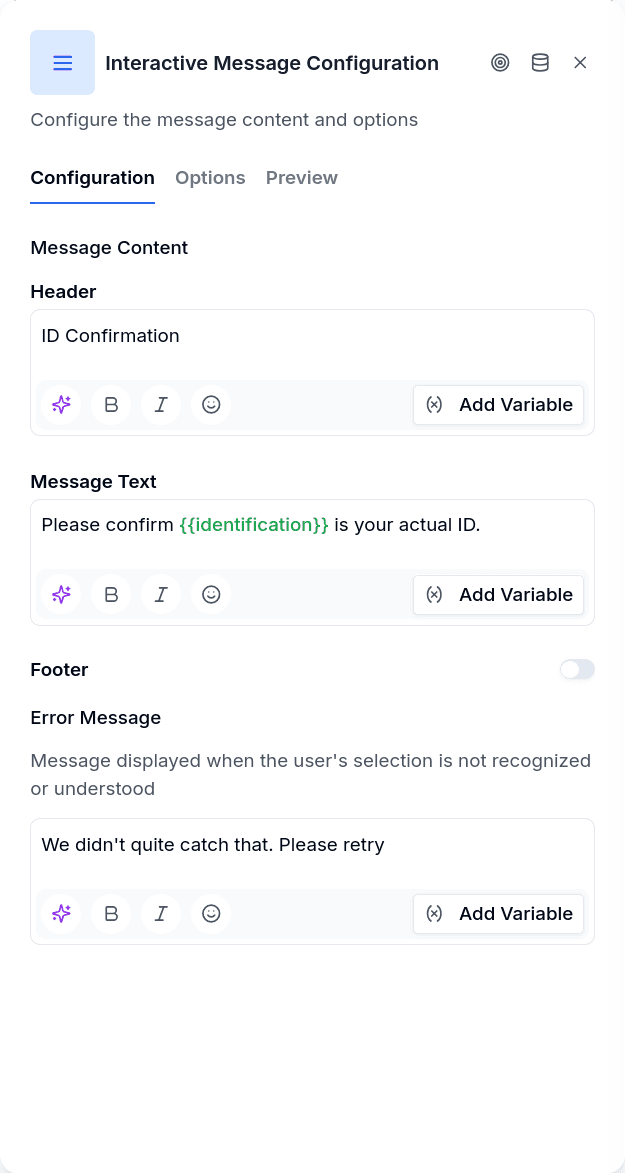
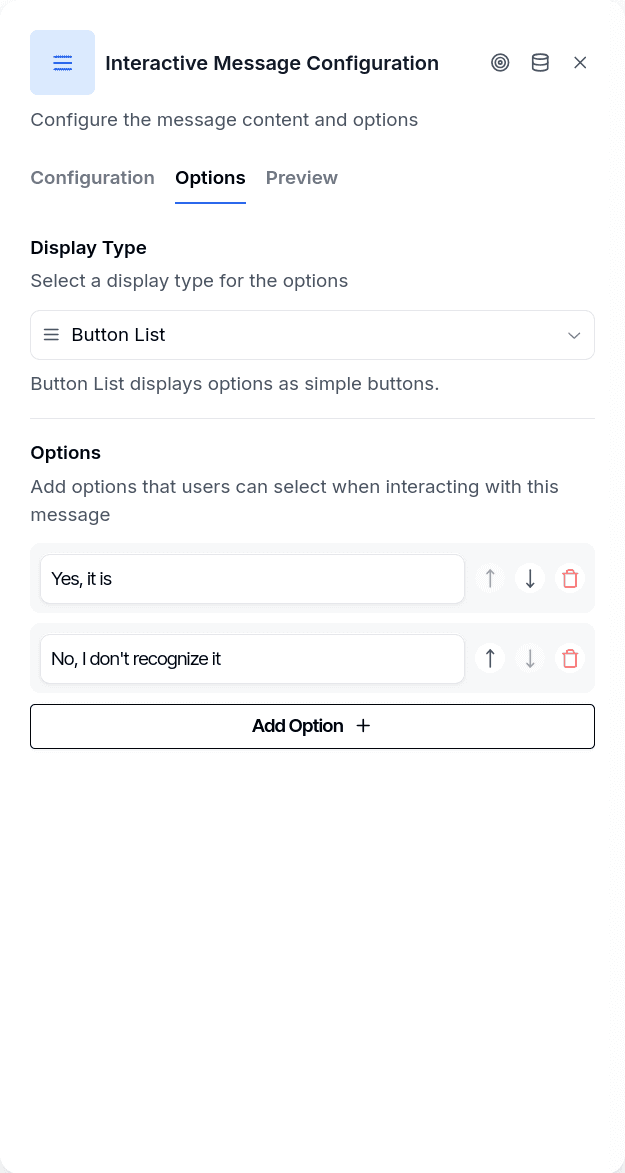
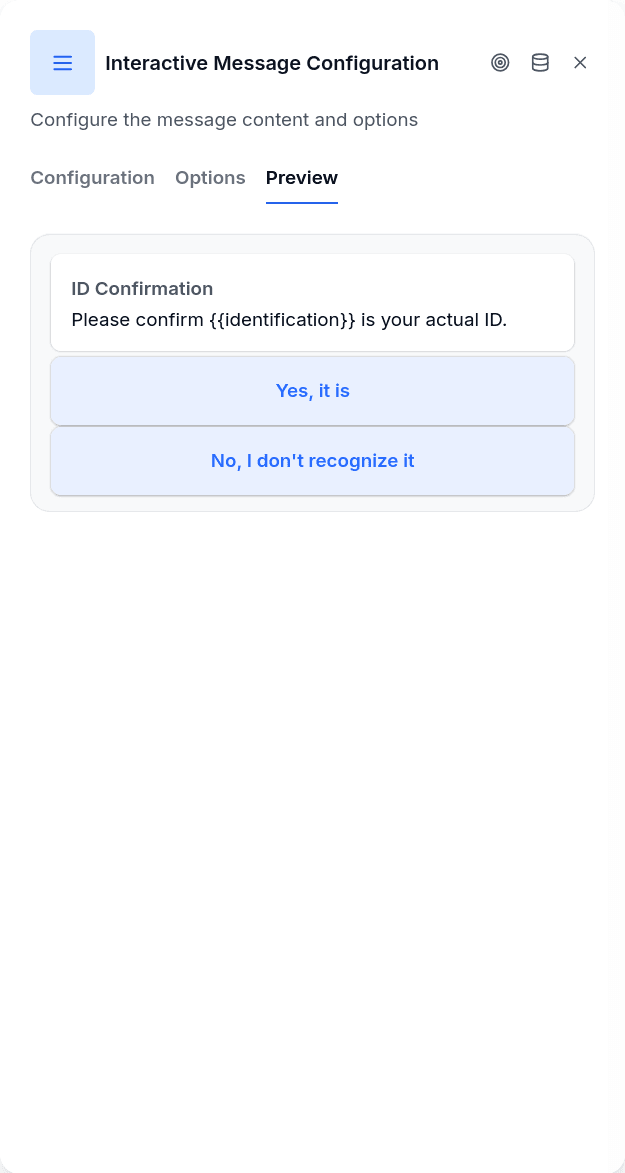
If the customer types a text response instead of selecting a button, the system attempts to match their text against the option labels. The match is case-insensitive — typing "natural" matches a button labeled "Natural." If nothing matches, the node shows an error message and waits for them to try again.
Display Types
By default, options appear as inline buttons below your message — the familiar quick-reply style. WhatsApp limits this to three buttons maximum. If you configure more than three options, the system automatically converts to a list format instead.
The list format shows a single button that opens an expandable menu. The button title setting controls what that button says — something like "Menu" or "Select an option." Use lists when you have many choices or when the options benefit from more space to describe them.
In practice, most implementations stick with buttons. Binary choices dominate: yes/no confirmations, correct/incorrect validations, two-path forks. These fit naturally into the button format.
When to Use It
Confirming data with the customer
After collecting or retrieving information, verify it before proceeding. Display the value in your message using variables and let them confirm or correct it: "Can you confirm this is your ID number: {{id_number}}?" with Yes and No buttons.
Routing by customer type
At the start of onboarding, ask what kind of entity they are. The answer determines which documents you request and which validation path to follow.
Offering recovery options after an error
When something fails — a validation error, a timeout, an unexpected result — give the customer a choice. "Retry" reconnects them to the previous step. "Talk to an agent" escalates to human support. This turns dead ends into decision points.
Single-option confirmations
Sometimes you need a "Continue" or "I'm ready" button rather than a choice. Configure one option and it functions as a checkpoint — the customer must tap it to proceed, ensuring they've read your message before moving on.
Message Structure
The node supports three text areas: a header (rendered bold, above the main text), the body text (your actual message), and a footer (smaller, grayed-out text below). Only the body text is required.
Variables work throughout — use {{variable_name}} to interpolate values stored earlier in the flow. This is especially useful for confirmation prompts where you're asking the customer to verify information they just provided.
WhatsApp Constraints
Button labels have a 20-character limit. Longer labels get truncated with an ellipsis. Keep labels short and action-oriented: "Retry" rather than "Click here to retry the verification process."
Headers and footers are optional styling — they help structure the message but aren't required. The body text carries the main content.
Output Handles
| Handle | When it fires |
|---|---|
| One per option | Customer selects that option (button or matching text) |
There is no error output. Invalid selections loop back to the same node with an error message until the customer makes a valid choice.