Ask Location
Ask Location collects a physical address from the customer. On WhatsApp, this can be a GPS pin they share from their phone; on any channel, it can be typed text. The node optionally geocodes the input into structured address fields and saves it as an Address entity linked to the borrower.
This matters for business verification and geodata analysis. When a customer claims their shop is at a certain location, you can capture that address in a format that's both human-readable (street, city, postal code) and machine-usable (coordinates). Later, you can verify the business actually exists there, run geographic reports, or check if the location falls within your service area.
Two Ways to Collect
The node operates in two modes depending on the literal address setting.
GPS mode (the default on WhatsApp) prompts the customer to share their current location using the phone's native location-sharing interface. They tap a button, confirm the GPS reading, and the system receives latitude and longitude coordinates directly. This is quick for the customer and produces precise coordinates, but it captures where they are right now — which may not be where their business is located.
Text mode asks the customer to type an address: "Av. 6 de Diciembre N34-120, Quito". The system then geocodes that text into coordinates. Text mode is the only option on web channels, where GPS sharing isn't available, and it's the right choice when you need the business address rather than the customer's current position.
Turning Input into a Structured Address
When Save as Address is enabled, the node creates an Address entity linked to the borrower's record with structured fields: street, neighborhood, city, state, postal code, country, and coordinates. On web channels, the node always collects typed text regardless of the mode setting.
For text input, the system geocodes to coordinates then reverse-geocodes to extract components. For GPS input, coordinates are already present — enable Enrich Address to reverse-geocode them into readable address fields, or leave it off if you only need lat/lon for mapping.
For more on how addresses are stored and managed, see the Address API.
Configuration
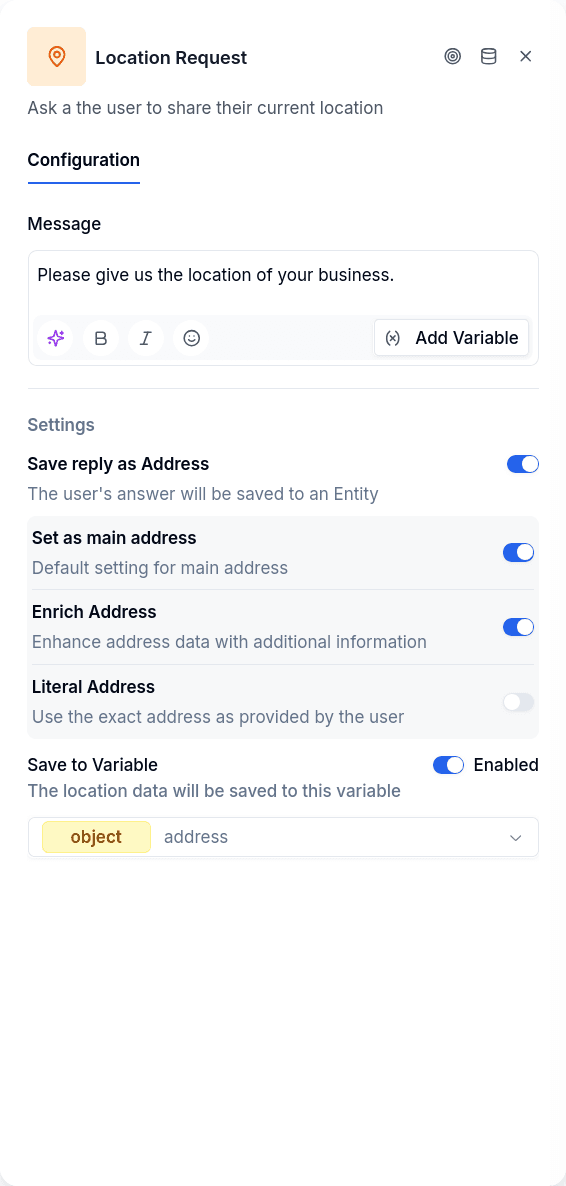
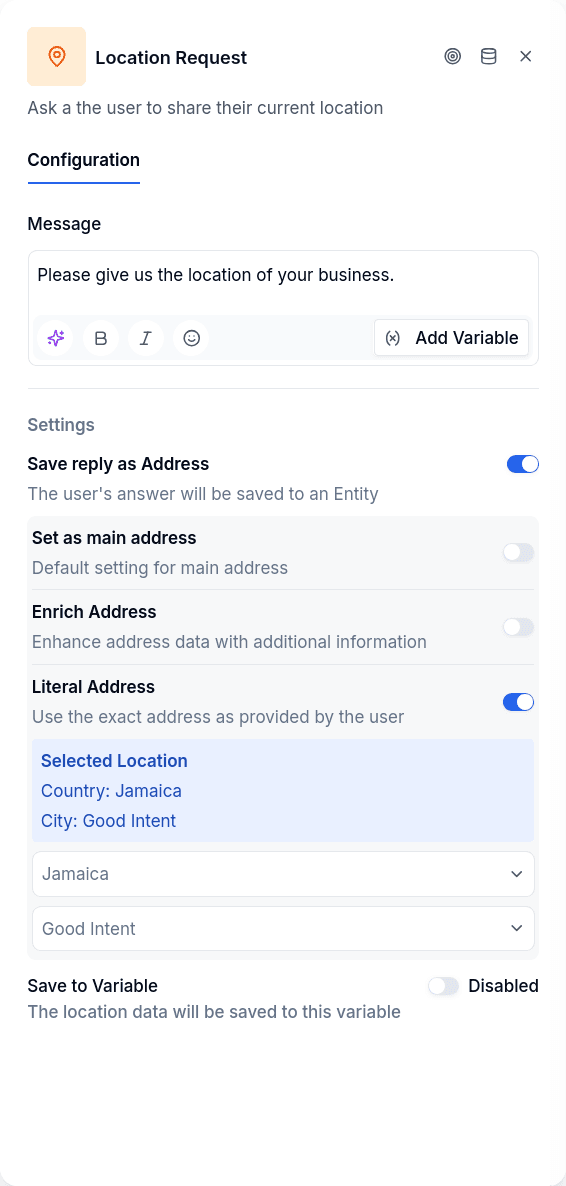
Enable Save as Address when you want the location stored as an Address entity on the borrower's record — this requires the customer to be authenticated. You can mark it as the main address, which sets it as the borrower's primary location.
For GPS input, enable Enrich Address to reverse-geocode the coordinates into readable street and city fields. For text input, enable Literal Address and optionally provide location data with the country and city to improve geocoding accuracy.
Specify which variable should hold the result. Without Save as Address, this contains the raw input. With it, this contains the full Address DTO including the generated entity ID.
What Gets Stored
Without Save as Address, the variable contains whatever the customer provided: a coordinate pair from GPS or the text they typed.
With Save as Address, the variable contains the full Address DTO with fields like street, neighborhood, city, state, postal code, country (normalized to ISO3 — "Ecuador" becomes "ECU"), and coordinates.
Output Handles
| Handle | When it fires |
|---|---|
| Continue | Location processed and stored successfully |
| Error | Borrower not found (when saving), or geocoding failed |
Prerequisites
Saving as an Address requires an authenticated borrower — the system needs to know whose record to attach the address to. If Save as Address is enabled but no borrower is logged in, the node routes to the Error handle.